Wednesday, August 7, 2013

Dean Toriumi: Nasal Injectable Fillers

What is a "pitfall nose", and how does it impact your surgery? 
Can Nasal Injectable Fillers Cause Damage? 
Dr. Dean Toriumi:
Patients are presenting with such complications as chronic infection, pain, persistent redness and swelling, and even permanent skin damage. Many of these patients are not able to undergo corrective surgery because their skin is damaged so severely that surgical correction would risk severe deformity or skin necrosis/loss.

There are numerous new injectable filler materials available for use in the United States. Restylane and Juvederm are hyaluronic acid derivatives and provide temporary contour changes. The hyaluronic acid filler materials last for approximately 6 months before dissolving away. Many surgeons feel this material is safe as it is not permanent, will go away, and not cause long term problems. Unfortunately, this is not always the case. Patients with thin skin are at much higher risk for problems associated with injectable filler materials. I have seen several patients who underwent Restylane injections by their surgeon and subsequently developed infections that permanently damaged the skin envelope of their nose. These problems occurred in patients who already had a thin compromised skin envelope or had an artificial implant in their nose.

If a patient has a minor irregularity and would like a temporary correction, Restylane or Juvederm is a reasonably safe option as it will eventually resorb and go away if injected correctly. The person who performs the injection must be cautious to inject deeply against the bone or cartilage and avoid injecting into the dermal layer, as this can permanently damage the skin envelope. If the patient undergoes secondary rhinoplasty before the material resorbs, the reconstruction will be more complicated and postoperative irregularities are more likely.
When I perform secondary rhinoplasty, I try to create a smooth cartilage and bone structure under the skin envelope. If the skin envelope is smooth and uniform, then the patient will likely have a good outcome with a smooth nose. If the nasal structure is smooth but the overlying skin envelope is irregular, the nose will be irregular. Filler materials can create this type of bumpy skin envelope that makes it more likely that the patient will have an irregular nose even though I may have performed a near perfect reconstruction of the nasal structure. By using cartilage grafts, we can do amazing things with reshaping the nose as long as the skin envelope is in good condition. Presence of an irregular skin envelope makes corrective surgery exponentially more difficult and in some cases makes getting a good outcome unlikely. Secondary rhinoplasty is hard enough without having to deal with these added variables.
There are also a new group of semi-permanent and permanent injectable filler materials such as Radiesse and ArteFill. Radiesse is hydroxyapatite particles suspended in a gel and lasts two years or more. ArteFill is polymethylmethacrylate beads in a collagen suspension that is permanent. Most who use these materials state that if injected deeply below the skin there is little risk to the patient. The problem with both of these materials is that they last for a long period of time and if injected more superficially, there will likely be permanent changes to the skin envelope. Surgical removal of these materials when placed superficially is very difficult and puts the patient at high risk for permanent skin damage or necrosis. One option is to leave the injectable filler material in the nose to avoid the risk of skin necrosis. The problem with leaving the injectable in the skin is that the skin envelope may be bumpy, resulting in multiple irregularities even after revision surgery. Another potential problem is that the filler material may eventually resorb, leaving the patient with a depression that has nothing to do with the reconstruction. The bottom line is that the presence of an injectable filler material creates numerous variables in the surgery that makes getting a good outcome much more difficult. These patients will be forced to accept multiple irregularities if they choose to undergo surgical correction.
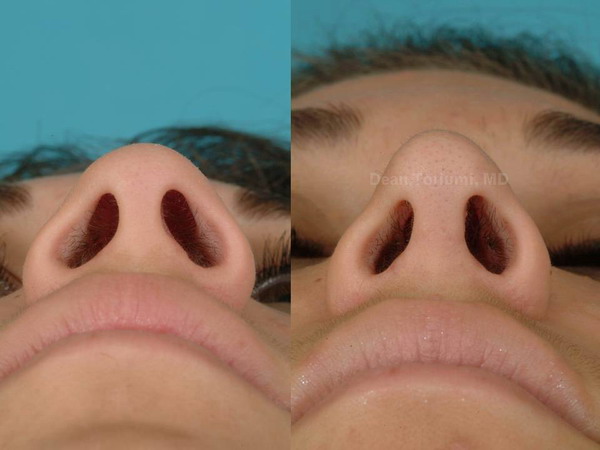
The patient shown below underwent a rhinoplasty and was left with a deviated nose. The surgeon injected Radiesse into the depression in his nose to create a straighter appearance. The patient then came to see me for secondary rhinoplasty. His surgeon told him that he had only injected 0.2 cc of the material and the Radiesse was likely gone. When I performed his revision surgery, his nose was full of this very gritty material that damaged his skin envelope and made the reconstruction exponentially more difficult. The surgeon injected the material in a more superficial layer of the skin envelope. I removed a large amount of this material that left a severely thinned skin envelope. I put this patient at risk for skin necrosis at the site that I removed the Radiesse. Fortunately, the skin did not necrose, and he is healing nicely. However, if I knew there was going to be that much Radiesse in his nose, I would have denied him surgery due to high risk for skin necrosis. 

Some of these filler materials have been available in Europe and Canada for many years. I have been treating patients from Europe and Canada with problems from injectable fillers for several years. Many of these patients had devastating problems that could only be corrected by performing procedures that risk skin necrosis, scarring, deformity and infection.

The patient shown below underwent treatment with a permanent injectable filler material to fill a defect in her nose. The surgeon injected the material in a superficial layer of her skin resulting in scarring of the dermal layer. She was having chronic infections and severe scarring from the injectable filler material. I performed a two stage secondary rhinoplasty to correct her problems. In the first stage I performed an open rhinoplasty approach and removed as much of the filler material that I could do safely. Her skin at the site of the resected filler material was very thin and blue indicating a compromised vascular supply. Fortunately she did not necrose her skin, but she did have long term redness in the skin at that site. In the second stage, I performed a reconstructive rhinoplasty with costal cartilage grafting. Two years after surgery, she is finally looking relatively good but still has some scarring at the site of the resection of the filler material.

before and after picture

before and after picture

before and after picture


before and after picture

before and after picture

before and after picture


before and after picture


I have shown two patients who have done well after undergoing resection of injectable filler materials. I have not had any skin necrosis in my patients because I am very careful when I remove the filler materials. Additionally, I am not operating on most of these patients with filler materials in their nose. If the filler was injected deeply and the skin moves freely over the site of the filler material, then surgical correction is much safer and can be very successful. I am turning away patients who underwent superficial injections with the skin adherent to the filler material and telling them that correction is too risky. These patients are left with the consequences of having a damaging filler material reside in their nose.

The most concerning phenomenon is that many dermatologists, generalists and surgeons are performing non-surgical rhinoplasties. In these cases, semi-permanent or permanent injectable filler materials are being injected into the nose to make long lasting contour changes. Some of those who are performing the injections are not rhinoplasty surgeons and may have little if any understanding of the nasal anatomy and nasal aesthetics. I have seen many patients treated by such physicians with severe nasal skin envelope problems such as infection, swelling, pain, permanent redness and deformity. Unfortunately, many of these patients cannot be helped because correction of the problem requires resection of the filler material. Resection puts these patients at severe risk of permanent skin damage in the form of intense redness or skin necrosis, leaving a hole in their nose. Additionally, we do not know the long term effects of such materials on the nasal skin envelope.
There is an intense need for scientifically sound research that demonstrates the safety and efficacy of these materials in the nose. Scientific research may show that these filler materials when placed deeply against the bone and cartilage are safe when used in the nose. The nose is a very important structure of the face that greatly influences the overall facial appearance. Caution should be taken when doing anything that could potentially damage the nose and leave the patient with a permanent deformity. 

Tuesday, August 6, 2013

Surgeon’s Review of Dr. Dean Toriumi’s Surgical Techniques

Personal experience visiting Dr. Toriumi   
- Jochen Wurm, M.D.    


During the last 3 years for two weeks at a time I had the great opportunity and privilege to visit Dr. Toriumi in his operating room and observe his surgery. From the very beginning he created a very warm and welcoming atmosphere for me as a guest from Germany. Also his fellows and his staff supported me with great efforts to get familiar with the environment and the routine work flow.My primary intention to visit Dr. Toriumi was to learn more details about his renowned surgical techniques I had watched so many times during various rhinoplasty meetings around the world. What Dr. Toriumi then offered me at his office exceeded all my expectations by far. Prior to the actual surgery he already shared his thoughts on how to prepare the patient and explained his surgical plan in detail. During surgery he paid very close attention to me being able to follow every single step of his work. Dr. Toriumi took additional time to make drawings for my better understanding. I also experienced his extensive efforts to illustrate all surgical techniques in a way that was easily understandable for me in order to overcome any possible language barrier. I was welcome to ask questions at any time and Dr. Toriumi was always willing to answer them in detail. I never had the impression he kept any secrets from me, he rather gave me the opportunity to get profound insight into his broad fund of tips and tricks in rhinoplasty.

I never had the chance to observe a surgeon who performed rhinoplasties with such patience and accuracy as Dr. Toriumi. He took care of any palpable or hardly even visible irregularity and asymmetry that most surgeons would not even recognize. He never finishes surgery until he achieved the best possible result for the patient – whatever it may take, even in the most difficult cases. As a colleague in facial plastic surgery I can only highly appreciate Dr. Toriumi´s outstanding and long-lasting results in rhinoplasty and facial plastic surgery in general.

Both professionally and personally being with Dr. Toriumi was a unique learning experience for me. His inspiring way of teaching enabled me to apply his advanced surgical techniques and attitude on my own patients with great success.

I am very grateful to have met Dr. Toriumi in person. I sincerely would like to thank him for giving me the opportunity to observe his surgery, last but not least also for his kindness and patience.

Therefore I am looking very much forward to meeting Dr. Toriumi again in the near future


Erlangen, Germany
July 24, 2013
Jochen Wurm, M.D.

Monday, August 5, 2013

Secondary Rhinoplasty surgeries: 2

Why does Dr. Toriumi only use rib cartilage for secondary rhinoplasty surgeries? 


Dr. Dean Toriumi:
After studying over many years the postoperative results in patients for whom I used ear cartilage in their surgery, I noted that there are specific deformities which are very difficult to correct with ear cartilage. There are several reasons for this, including the fact that there is a limited amount of ear cartilage, and ear cartilage is weaker than both septal and rib cartilages. In fact, rib cartilage is by far the strongest cartilage. Some of these deformities difficult to correct with ear cartilage include the short nose or over rotated nose, the severely under-projected nose, noses that require major dorsal augmentation (such as a saddle nose deformity), the severely pinched nose, the severely deviated nose, and patients with severe alar retraction. When I used ear cartilage to correct such deformities, I found that the ear cartilage was relatively weak and tended not to hold up over time, resulting in persistence of the deformity or recurrence of the deformity 2 to 5 years after surgery. Over time, I have found that I am able to better correct such deformities with rib cartilage and see longer-lasting, predictable results.
The patient shown below came to see me with an under projected tip. I performed a secondary rhinoplasty using ear and septal cartilage. In her two year postoperative results, one can see that I was able to project her nasal tip. However, at five years after surgery, her nose shortened (rotated) significantly, leaving her with a short nose and too much nostril show on the frontal view. She requested to have her nose lengthened, as she prefers a longer nose with a convex dorsum. After her revision with rib cartilage, her nose is longer with less nostril show on frontal view and a small dorsal convexity. 

Secondary Rhinoplasty surgeries

Why does Dr. Toriumi only use rib cartilage for secondary rhinoplasty surgeries? 

Answer by Dean Toriumi:
The short answer is that I don't only use rib cartilage for such surgeries.
I prefer to use rib cartilage for secondary rhinoplasty cases primarily because most of these noses are depleted of structure, and ear cartilage may not be adequate to do a satisfactory reconstruction. However, many patients can be corrected using ear cartilage and whatever septal cartilage is remaining. In fact, I used primarily ear cartilage for the first 15 years of my practice with good success.

Shown below is a patient who underwent successful reconstruction with ear cartilage and is now five years out from surgery. She initially presented with a deformed nasal tip (nasal tip bossae). We performed a reconstruction using ear cartilage, and she has done well over the past five years with a good aesthetic outcome. The first set of photos shows the preoperative views and the five-year postoperative views. Note how the tip deformity has been corrected. In the second set of photos one can see the degree of increase in definition that occurred from the second to the fifth year. Frontal view shows significant narrowing of the nose and nasal tip from the second to the fifth postoperative years. Lateral view shows how the supratip fullness resolved without any intervention. This illustrates how the nose continues to shrink over time. 


Friday, August 2, 2013

Dr. Toriumi's operation to correct the crooked nose deformity

Why does Dr. Toriumi use such a complex operation to correct the crooked nose deformity? 

Straightening crooked noses is one of the most difficult tasks in rhinoplasty. Crooked noses can occur for many different reasons. These include prior trauma or asymmetric nasal growth. Deformities can be broken down into two major categories. These include bony deviations (upper half of the nose), and cartilage deviations (lower half of the nose). Bony deviations can frequently be corrected with osteotomies or creating controlled fractures in the nasal bones and shifting them back to the midline. Deviations of the cartilaginous part of the nose (lower half of the nose) tend to more complex and more difficult to correct. Many of the deviations of the lower third of the nose involve deviations of the underlying nasal septum. In some cases less complex surgeries can correct deviations of the lower half of the nose. However, the incidence of failure is higher when an operation does not successfully straighten a deviated septum. Nasal function is also maximized by creating a straight nasal septum. My intent with deviated noses is to create a straight nose but also to straighten the nasal septum to maximize nasal function.

The method that I use to correct more severe deviations of the cartilaginous portion of the nose involves disassembling the lower third of the nose, straightening or replacing the septum and then putting the nose back together in the midline. Unfortunately, this is a more complex operation and may require additional cartilage grafting material. In fact we will frequently use costal cartilage (rib cartilage) in more severe cases or when correcting previous operated noses that remain deviated. Patients who have not undergone previous surgery may be able to be corrected using their existing septal cartilage for reconstruction. However, in many cases I will actually remove and replace the deviated or damaged septum and replace it with a new straight structure that will allow placement of the nose in the midline. This is a more complex operation and takes up to 5 or 6 hours. However, the success rate in getting the nose straight is much higher when the underlying septum is straight. Few surgeons choose to perform this type of surgery as it is very time consuming and complex. When I operate on a nose I take as much time that is necessary to create the intended result, and my success rate with deviated noses is excellent.

If the septum is not straightened and well supported the nose will initially look straighter and then tend to deviate with the passage of time. The nasal breathing may also become restricted with time as the septum deviates. This can be very frustrating to the patient as he or she may initially think that the nose was fixed. Early on swelling will hide deviations that can become more evident with the passage of time. It is important to keep in mind that getting a nose perfectly straight is very difficult. Most noses are significantly improved and may have a residual minor deviation or asymmetry. The frontal view of your nose is by far the most difficult view to make symmetric. This is because when light strikes your nose it casts shadows and these shadows are what makes the nose look asymmetric. I spend a great deal of time working on the frontal view at the time of surgery because I know that it is this view that is the most difficult to make symmetric.

Some surgeons will recommend injecting the nose with filler materials to help correct asymmetries or residual deviations. I do not recommend this type of management unless the patient has no intent on undergoing any revision surgery. Such injections can become infected and more importantly they create increased scarring that can compromise the success of any future revision surgeries. I have turned away numerous patients for secondary rhinoplasty because of previous injections with fillers. Permanent fillers are the most damaging whereas temporary fillers (Restylane or Juvederm) will resorb after 8 to 12 months. If permanent fillers are used the skin of the nose is permanently altered making it exponentially more difficult to get a smooth nasal contour. With permanent fillers the skin can be permanently damaged to the point that it is infected, discolored, irregular or permanently damaged. Unfortunately, I have seen many of these problems since injectable filers have been used. 

Illustrative patient cases:

This patient came to see me to have her nose straightened. She had no previous surgery and has nasal obstruction due to a deviated septum. Correction of her nose required using her own septal cartilage to straighten her nose. We did not take cartilage from any other location other than her nose. Her face is a bit asymmetric and this made her surgery more difficult. Postoperatively her nose is straight and her septum is straight. Her nasal breathing was very good. 


This patient underwent two previous surgeries to straighten his nose and fix his nasal obstruction. After his surgery he was left with persistent nasal obstruction. He came to my office requesting correction of his nasal obstruction and straightening of his nose. I performed a secondary rhinoplasty with costal cartilage grafting to reconstruct his septum. I removed his deviated septal cartilage and replaced it with costal cartilage. Postoperatively his nose is straight and his nasal breathing is much improved. I also straightened his nasal dorsum to create an improved dorsal profile. 


Wednesday, July 31, 2013

Can Dr. Toriumi work with big and wide noses?

Can Dr. Toriumi work with big and wide noses?

Some patients just cannot have a small nose based on their anatomy, skin thickness, or effects from previous surgery. In the ideal setting all patients would have whatever sized nose that they want. Unfortunately, this is not reality.

Patients who have thinner, pliable skin and noses that are larger are more likely to tolerate a significant downsizing of their nose. In these patients, their thinner skin will tend to shrink over time to accommodate the reduction in their nasal cartilage and bone structure. This shrinkage may take many months or even years. Therefore, these patients will likely be unhappy early on, before their swelling subsides and the skin shrinks to accommodate the new nasal structure. If the nose is made too small, the skin may never completely contract and may leave a deformity.

For most rhinoplasty patients Dean Toriumi will perform digital imaging during the initial consultation to demonstrate what he feels is a realistic outcome. Dean will try to make the nose smaller if he feels the skin will accommodate such a change. This requires a great deal of judgment, and Toriumi prefers to make a nice improvement by decreasing the size of ones nose by a safe degree as opposed to making it too small and having the skin droop.
Illustrative patient cases:

The patient shown below had a prominent overprojected asymmetric nasal tip and wide dorsum. In order to create better balance in her nose Dean Toriumi decreased her nasal tip projection. Her preoperative computer imaging showed a larger nose than what was achieved at the time of surgery. Because her skin was relatively thin and redraped well he was able to make her nose smaller than the preoperative computer imaging. Toriumi also narrowed her bridge and straightened her asymmetric nasal tip.


In following my patients over many years, I have found that the middle vault region (mid portion) of the nose tends to narrow dramatically over time. Patients on whom I operated tended to develop narrowing of the middle vault region over many years. In patients with thinner skin and shorter nasal bones, their middle vault region tended to narrow too much and become pinched years after surgery.

The patient shown below was operated on 9 years ago. She had a bulbous tip and dorsal hump. I performed a dorsal hump reduction and placed spreader grafts. Despite the spreader grafts her middle nasal vault gradually collapsed over many years. The collapse occurred because the patient has thin skin, short nasal bones and long upper lateral cartilages. If this patient had thick skin her deformity would be less prominent. This patient needed thicker spreader grafts or a slight degree of overcorrection of her middle nasal vault to prevent this collapse. By following my patients long term I am able to see these problems and make adjustments in my technique.


Tuesday, July 30, 2013

Dean Toriumi Reviews: Severely deviated nose with nasal airway obstruction

Testimonial #24

This patient presented with a severely deviated nose with nasal airway obstruction. She desired a straight nose and improved nasal function. The patient also has thin skin which makes the surgery more complicated and very difficult to create a straight nose.

My decision to go to Dr. Toriumi for my primary rhinoplasty was actually a very simple decision. I wanted the best possible outcome performed by the best possible team. I wanted to make certain this would be my first and last rhinoplasty because I was only going to have it done in the first place if it was done right the first time. 

Dr. Toriumi is world renowned for his perfectionism and for this surgery, I wanted nothing less. I was also very impressed with the care he takes in not only the appearance, but primarily the function of the airways and the technical correctness of his work and the well being of his patients. Dr. Toriumi also has an amazing staff that made me feel very comfortable throughout the process. My pre-op and post-op follow ups have been nothing short of pleasant with all of my questions answered. My surgery day was just as comfortable, and I was well taken care of by the nurses and Dr. Toriumi himself, who actually checked in on me hours after my surgery.

~ K.M.